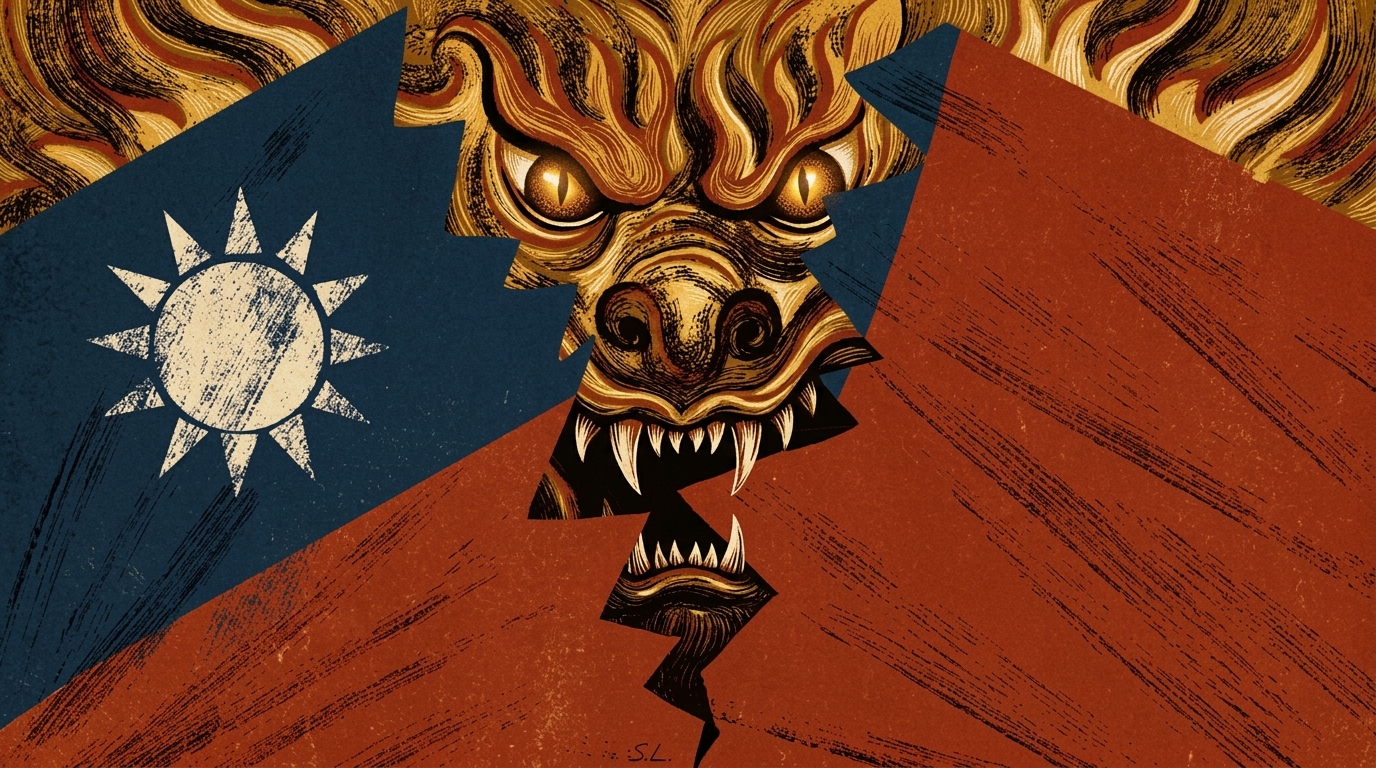
圖說:撕裂的旗幟與深淵後的巨龍——象徵內部政治撕裂與外部專制吞噬的雙重危機。
KAMI EDITORIAL / LITHOGRAPH STYLE
《經濟學人》專欄全文翻譯:外界多關注軍事入侵或封鎖,但若台灣在內部妥協派斡旋下「和平逼降」,習近平將面臨殘酷的清算與治理代價。台灣的民主制度不僅是歷史進步,更是提高統治代價的戰略威懾;然而,自私的政客與內部惡鬥正親手摧毀這道防線。
習近平要拿下台灣,得對多少年輕人開槍?這座島嶼上的年輕人,在感到被統治者背叛時向來有發起大規模抗議的記錄。試想一下:若在親妥協派的台灣菁英斡旋下,中國強行接管了台灣,屆時會由誰的軍隊來清場?又會動用何種致命武力?
HOW MANY kids would Xi Jinping shoot to take Taiwan? The island’s youngsters have a record of staging mass protests when they feel betrayed by their rulers. Imagine a coercive Chinese takeover, brokered by pro-appeasement Taiwanese elites. Whose troops would clear the streets, and with what lethal force?
來自中國的征服者是否會透過樣板審判(show trials),向台灣大眾宣告自治已經終結,伴隨而去的還有歷時三十年的多黨民主試驗?中國早已備妥法律工具:2005 年通過的《反分裂國家法》,隨時可用來對付「頑固台獨分子」。
對於已連續贏得過去三屆總統大選的民進黨(DPP)而言,這是令人不寒而慄的言論。民進黨強調台灣獨立自主的身分認同,並反對中國對該島的主權主張。中國官員曾痛斥台灣總統賴清德為叛國之徒。而《反分裂國家法》中最嚴重的罪名——例如「分裂國家罪」——最高可判處死刑。
Would Chinese conquerors use show trials to teach the Taiwanese public that self-rule has ended, and with it, their 30-year experiment with multiparty democracy? China has a legal instrument prepared: an anti-secession law passed in 2005, ready to use against “diehard Taiwan independence elements”.
That is chilling talk for Taiwan’s Democratic Progressive Party (DPP), which has won the past three presidential elections. The DPP emphasises Taiwan’s separate identity and opposes China’s claims to the island. Chinese officials have called Taiwan’s president, Lai Ching-te, a traitorous rat. The gravest charges in the anti-secession law, such as “splitting the state”, are punishable by death.
那麼台灣的公務人員呢?在台灣成為中華人民共和國的一個地區後,為了確保符合中國宣稱的目標——只有「支持國家統一」者才能任職,會有多少人遭到監禁或解雇?
先例早已存在。在 2019 年反政府示威席捲香港之後,掌控該地的北京統治者便要求香港當地的官員與政治人物宣誓效忠,否則就予以清洗。
What of Taiwan’s public servants? How many would be jailed or sacked, to ensure that, in line with China’s stated goals, only those who “support the reunification of the country” hold office after Taiwan becomes a region of the People’s Republic of China?
The precedent exists. After anti-government protests swept Hong Kong in 2019, that territory’s Chinese overlords demanded that local officials and politicians take loyalty oaths or be purged.
中國官員曾提及在接管台灣後開展「再教育」運動的必要性。在這座擁有 2,300 萬人口的島嶼上,民調一再顯示絕大多數民眾傾向於某種形式的自治,這意味著可能會有數百萬人必須接受這種教育。
此外,還有台灣引領全球的半導體產業,供應全球超過 90% 最先進的晶片。這項高科技奇蹟全仰賴技術精湛的工程師。若他們試圖逃離,中國會將他們鎖在晶圓廠裡嗎?
Chinese officials have talked of the need for re-education campaigns in post-conquest Taiwan. On an island of 23m people, where surveys consistently show that a large majority of the public favour some form of self-rule, millions might have to enroll.
Then there is Taiwan’s world-leading semiconductor industry, which churns out more than 90% of the most advanced chips used around the globe. Skilled engineers make that high-tech wizardry happen. If they try to flee, would China lock them in their fabs?
外界在評估潛在的台灣危機時,通常著眼於中國發動入侵或封鎖的風險。這很自然,因為若美國出面協防該島,兩個擁有核武的超級大國將陷入戰火。
但另一種情境同樣值得探討:如果台灣在未經一戰的情況下被誘降——這顯然是中國的首選——習先生及其部屬將面臨一連串可怕的抉擇。要徹底粉碎台灣的自由,可能需要殘酷的鎮壓,而這一切將呈現在全世界眼前。對台灣的政治人物而言,結論應當顯而易見:他們的民主制度不僅僅是對 1949 年國共內戰落敗後流亡當地的蔣介石獨裁統治的一種改良,他們的政治體制本身就是一種威懾力量。
When outsiders study possible Taiwan crises they typically weigh the risks of a Chinese invasion or blockade. That is natural. If America were to intervene to defend the island, two nuclear-armed superpowers would be at war.
But another scenario merits study, too. If Taiwan is ever induced to surrender without a fight—China’s clear preference—Mr Xi and his underlings would face a series of horrible choices. Brutal repression might be needed to crush Taiwan’s freedoms, and would be seen around the world. The conclusion should be obvious to politicians in Taiwan. Their democracy is not just an improvement on the dictatorship that ruled the island after Chiang Kai-shek, the loser of China’s civil war, fled to exile there in 1949. Their political system is a deterrent.
台灣迫切需要更多能讓習先生有所顧忌的籌碼。中國並不懼怕台灣的武裝部隊,儘管民進黨正試圖推動早就該進行的軍隊現代化。而台灣傳統上的保護者——美國——卻是一個靠不住的朋友。
雖然唐納·川普(Donald Trump)總統批准了創紀錄的對台軍售,但他同時也嘲諷台灣的軍力在強大的中國面前微不足道。在 5 月於北京與習先生會談後,川普更附和了中方論調,稱賴總統是個可能挑起戰爭的「莽撞之徒」。
Taiwan is sorely in need of more things that would make Mr Xi pause. China has no fear of Taiwan’s armed forces, though the DPP is trying to push through their long-overdue modernisation. Taiwan’s traditional protector, America, is an unreliable friend.
President Donald Trump has agreed record-breaking arms sales to Taiwan, yet he also mocks it as outgunned by mighty China. After talks with Mr Xi in Beijing in May, Mr Trump echoed Chinese talking-points that call President Lai a hothead who may start a war.
遺憾的是,出於私利的政客非但沒有珍視台灣的民主,反而在摧毀它。自 2024 年勢均力敵的選舉之後,民進黨掌握了總統職位與行政部門,但由國民黨(蔣介石的繼承者)領導的在野黨控制了立法院,隨之而來的黨派惡鬥使政府施政寸步難行。
Alas, far from prizing Taiwan’s democracy, self-interested politicians are breaking it. Partisan feuding has hobbled the work of government since a close election in 2024 left the DPP in control of the presidency and the executive branch, but the opposition, led by the KMT (Chiang Kai-shek’s heirs), controlling the parliament.
許多國家都有惡質的政客,但台灣政客的不負責任尤其引人注目。雙方責任並非各打五十大板:賴總統固執己見,未如其前任蔡英文那樣向國民黨溫和派徵詢意見;然而,在野陣營卻引發了連環憲政危機。
國民黨立委及其盟友阻擋政府預算長達數月,包括採購美製武器的經費。他們還杯葛憲法法庭的大法官人事任命,導致大法官人數大幅縮減,以致剩餘的法官甚至無法就開會是否達到法定人數以處理政府僵局達成共識。
Lots of countries have toxic politicians. Taiwan’s stand out for their irresponsibility. The blame is not evenly distributed. President Lai is stubborn and does not consult KMT moderates as his predecessor, Tsai Ing-wen, did. But the opposition has triggered a rolling constitutional crisis.
KMT legislators and their allies held up government budgets for months, including funds for American arms. They have blocked judicial appointments to the constitutional court, leaving it so shrunken that its remaining judges cannot agree if they are quorate to tackle gridlock in government.
在一場戲劇性的「自我傷害」之舉中,在野黨擱置了透過採購 21 萬架空中與海上無人載具來啟動本土無人機產業的計畫。台灣需要無人機,在電子領域具備優勢,還能將產品出口至急需非中國製設備的西方國家。然而,國民黨主導的預算爭端卻讓新的無人機訂單最早要拖到明年才能成行。
本專欄作者造訪台灣時,曾邀請國民黨高層作出解釋。「噢,我們支持製造無人機,」他們說,「但這是政治問題。」一位黨內要角私下坦言:「說坦白點,國民黨立委擔心政府會把無人機經費流向捐款給民進黨金庫的企業。」
當被問及親國民黨的企業是否能製造無人機時,這位要角嘆了口氣。該名知情人士解釋,親藍企業通常在中國有投資,因此不敢涉足,「黨內寧可不去面對這個兩難困境。」
In a dramatic act of self-harm, the opposition has held up plans to kick-start a domestic drone industry with orders for 210,000 air and sea drones. Taiwan needs drones, is good at electronics and could also export to Western countries desperate for non-Chinese kit. Yet KMT-led budget squabbles are blocking new drone orders until next year, at the earliest.
Visiting Taiwan, your columnist invited KMT high-ups to explain. Oh, we support dronemaking, they said, this is political. Let me be blunt, confided a bigwig: KMT legislators fear the government will channel drone funds to firms that donate to DPP coffers.
Asked whether KMT-friendly firms could make drones, then, the bigwig sighed. Pro-KMT firms often have investments in China so would not dare, the insider explained: the party prefers not to face up to this dilemma.
分化而治之:民進黨政客譴責國民黨主席鄭麗文宣稱台灣不能依賴美國、因此必須加強與中國關係的言論。當她 4 月於北京與習先生舉行友好會晤時,民進黨感到極度憤怒。鄭女士堅稱其目標是避免戰爭,而非出賣台灣。民進黨內部人士則指控其黨內部分人士實際上充當了中國的「代理人」。
毫無疑問,台灣正是中國影響力作戰(認知作戰)的目標。這些手段是否奏效尚不明確;然而,台灣最年輕的一代對政治愈發感到幻滅,投票意願也在降低。與此同時,這群年輕人正受到具有中國官方背景的社群媒體鋪天蓋地轟炸,嘲笑台灣的民主一片混亂。
Divide and be conquered: DPP politicians condemn the KMT’s chairwoman, Cheng Li-wun, for declaring that Taiwan cannot rely on America and so needs to strengthen ties with China. They were angry when she held friendly meetings with Mr Xi in Beijing in April. Ms Cheng insists that her goal is to avoid a war, not to sell Taiwan out. DPP insiders allege that some in her party, in effect, act as “surrogates” for China.
There is no doubt that Taiwan is the target of Chinese influence operations. It is unclear whether these work. That said, the youngest Taiwanese are growing disillusioned with politics and less willing to vote. The same group is bombarded with mainland-backed social media mocking Taiwan’s democracy as chaotic.
體制失靈正在傷害台灣。從獨裁走向開放社會的歷程,徹底改變了台灣的國際地位。然而,外人對其民主的珍惜,不可能超越台灣自身的政治人物。
台灣的自由本該是一項優勢,能提高中國接管的代價。令人蒙羞的是,這份自由如今正遭到內部的背叛。■
Dysfunction is hurting Taiwan. Its journey from dictatorship to open society has transformed its global standing. But outsiders cannot love its democracy more than its own politicians do.
Taiwan’s freedoms should be a strength, raising the costs to China of a takeover. Shamefully, they are being betrayed from within. ■
| 情境維度 (Scenario Dimension) | 若中國採取武力犯台 / 封鎖 (Invasion / Blockade) | 若台灣遭誘降 / 妥協接管 (Coercive Takeover / Surrender) |
|---|---|---|
| 國際軍事反應 (Military Response) |
引發美國介入風險,美中兩大核武強權直接開戰。 | 無直接軍事交火,但全球面臨地緣政治秩序劇烈重組。 |
| 內部社會治理代價 (Governance & Repression) |
戰火造成嚴重基礎設施與人命損失。 | 必須動用致命武力清場青年抗議,設立數百萬人再教育營,發動香港式公務員大清洗。 |
| 半導體產業衝擊 (Semiconductor Sector) |
晶圓廠面臨摧毀或全球供應鏈全面中斷。 | 關鍵工程師面臨逃亡潮,北京恐將工程師鎖在廠區進行人身控制。 |
| 法理清算與公審 (Legal Purges & Trials) |
戰時軍事管制。 | 啟動 2005《反分裂法》死刑條款,對民進黨及政治領袖展開公開樣板公審。 |
| 最大當前破口 (Current Vulnerability) |
國防現代化進度落後、美方態度曖昧。 | 政客內部撕裂:杯葛 21 萬架無人機預算、癱瘓憲法法庭、青年對民主制度幻滅。 |