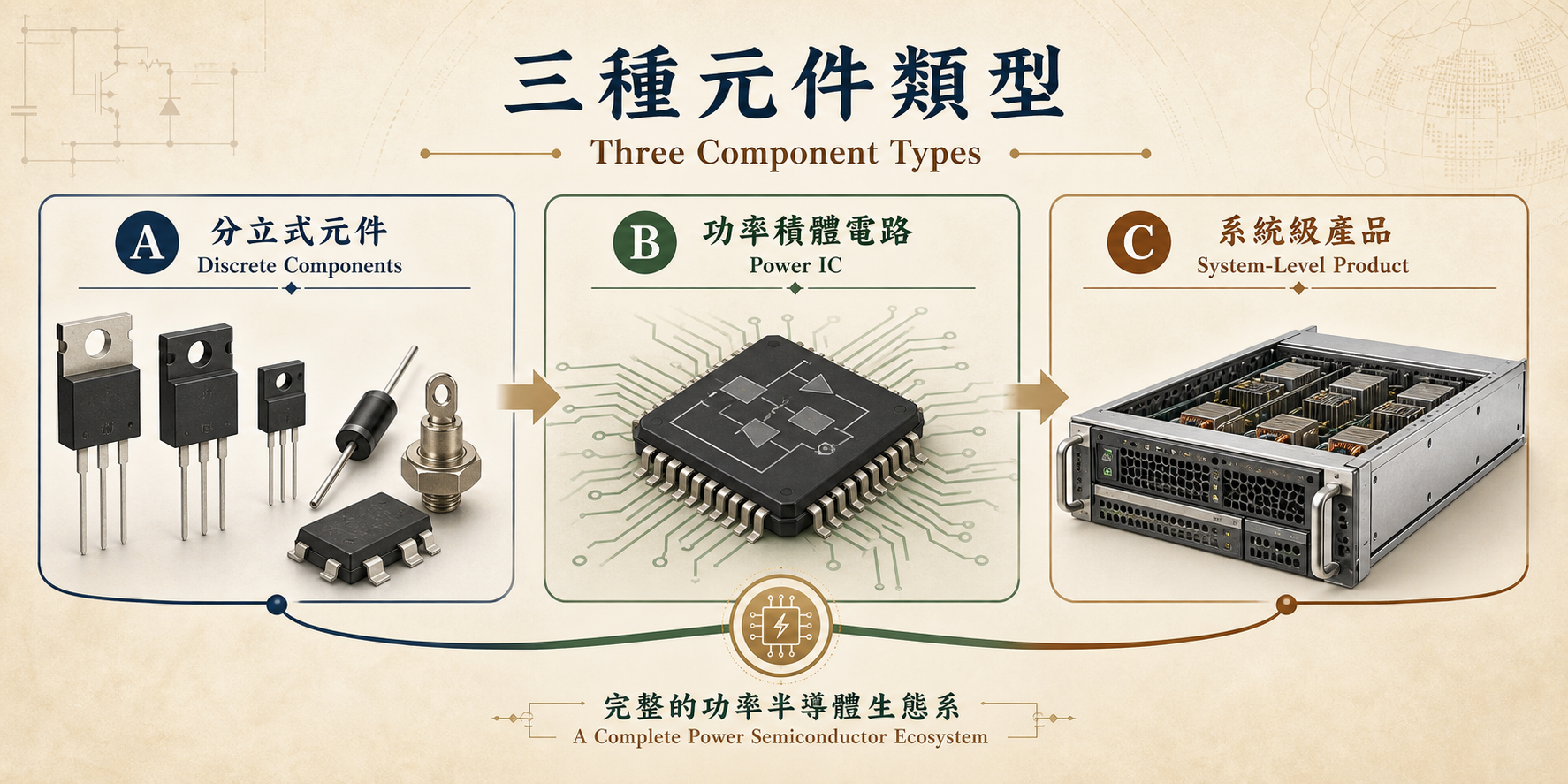
同樣都叫「功率半導體」,但離散元件、功率 IC、系統級產品的毛利、設計週期與驗證方式截然不同——這直接影響你如何評估每一檔股票。
All called "power semiconductors," but discrete, Power IC, and system-level products have completely different margins, design-in cycles, and verification logic — this changes how you evaluate each stock.
在上一課我們建立了「從插座到 GPU」的功率樹。現在要在這棵樹上面深挖:每個節點上跑的元件,到底是哪一種?因為同樣在「功率半導體」裡,離散元件和功率 IC 對投資人而言是完全不同的故事。
它做什麼:只做一件事——開、關或整流。沒有內建邏輯。它不「決定」何時動作,它只是「執行」別的晶片送來的指令。
What it does: One job only — switch, block, or rectify. No embedded logic. It doesn't decide when to act; it just executes the command another chip sends.
主要產品 Key Products:
台股對應 Taiwan Stocks: 朋程 8255 強茂 2481 台半 5425 杰力 5299 富鼎 8261 尼克森 3317 德微 3675
「高壓 MOSFET 或 Superjunction 占比是否提升?」「AI server PSU / HVDC 客戶有無新 design-in?」「IDM 轉來的訂單毛利率是否和自有業務相近?」
Is high-voltage MOSFET mix rising? Any new AI PSU / HVDC design-ins? Are IDM-transferred orders at similar margin to own business?
它做什麼:負責「思考」。它監控電壓、電流、溫度,然後告訴離散元件(通常是 MOSFET)該怎麼動。功率 IC 越精密,整個電源系統就越高效、越省電。
What it does: It "thinks." Monitors voltage, current, temperature, then tells discrete devices (usually MOSFETs) how to act. The smarter the Power IC, the more efficient the whole power system.
主要產品 Key Products:
台股對應 Taiwan Stocks: 茂達 6138 富鼎 8261 致新 8081 力智 6719
「DRMOS 或 Gate Driver 有無被 AI server 新平台(Rubin / GB300)採用?」「相數提升帶動的 per-server 價值量是多少?」「GPU OEM / ODM 的設計導入時程?」
Is DRMOS / Gate Driver designed into new AI server platforms (Rubin / GB300)? What's the per-server value uplift from more power phases? What's the design-in timeline with GPU OEM / ODM?
它做什麼:把功率 IC、離散元件、電感、電容、機械設計整合成一個完整的「電源模組」或「保護單元」交給客戶。客戶買的不是某顆晶片,而是「這個機架的供電問題解決了」。
What it does: Integrates Power ICs, discretes, passives, and mechanical design into a complete module. The customer buys a solved problem — "this rack's power delivery is handled" — not individual chips.
主要產品 Key Products:
台股對應 Taiwan Stocks: 台達電 2308 光寶科 2301 松川精密 7788
「800VDC power rack 是展示還是已有客戶計劃出貨?」「AI data center 的 PSU / power shelf 訂單能見度到哪一季?」「DC relay 在 HVDC 架構的 attach rate 是多少?」
Is the 800VDC power rack a demo or an active customer program with shipments? What's the PSU / power shelf order visibility? What's the DC relay attach rate in HVDC architecture?
| A 離散元件 Discrete |
B 功率 IC Power IC |
C 系統級 System |
|
|---|---|---|---|
| 毛利率 Gross margin |
25–38% | 40–55% | 15–28% |
| 設計導入 Design-in |
1–3 個月 | 6–18 個月 | 12–24 個月 |
| 客戶黏性 Stickiness |
低:規格對就能換 | 高:換會打亂設計 | 極高:換要重驗整架 |
| 主要驗證訊號 Key signal |
月營收 YoY 連續加速 毛利率改善 |
平台 design-in 確認 相數 / ASP 提升 |
從展示走到出貨 客戶計劃 / 具名客戶 |
| IDM 轉單? IDM transfer relevant? |
✅ 直接受益 標準品產能外溢 |
❌ 不直接相關 設計能力是護城河 |
❌ 不適用 系統整合商競爭 |
| 800V 直接受益? Direct 800V beneficiary? |
部分:高壓 MOSFET 前段整流 |
間接:GPU 功耗增 → VRM 相數增 |
✅ 最直接 系統架構變了就要換 |
設計導入越長,代表:① 一旦進去就很難被踢出,② 但要等比較久才會看到營收。這個時差決定了你何時入場以及設多寬的停損寬容度。
用系統級的訊號去等離散元件的速度。台達電宣布拿到 800VDC 訂單(系統級),不代表朋程下個月月營收就會爆發(離散,設計導入 1–3 個月,但還要等 ODM 真正出貨)。反過來也一樣——茂達的 DRMOS 進了 Rubin 平台(功率 IC,驗證需 6–18 個月),不能用「這個月月營收好不好」來判斷這件事有沒有成立。
Don't use system-level signals to time discrete stocks, or vice versa. 台達電 winning a 800VDC contract doesn't mean 朋程's revenue spikes next month. And 茂達's DRMOS entering the Rubin platform (6–18 month design-in) can't be judged by this month's revenue alone.
注意 DRMOS 比較特殊:它把 Gate Driver(類型 B)和 MOSFET(類型 A)整合在同一個封裝裡。這就是為什麼茂達的毛利率比純做離散的富鼎要高。
Note: DRMOS is a hybrid — it integrates a Gate Driver (Type B) and a MOSFET (Type A) in one package. That's why 茂達's gross margin is higher than a pure discrete player like 富鼎.
用上面學到的框架回答——每個選項長度相同。
Apply the framework above — all options are the same length.
1. 強茂(2481)主要做整流橋、Schottky 二極體、高壓 MOSFET。它屬於哪一種元件類型?這對驗證方式有什麼影響?
強茂 makes rectifier bridges, Schottky diodes, high-voltage MOSFETs. Which type is it — and how should you verify it?
2. 茂達(6138)的 DRMOS 被一家 GPU ODM 採用進入 Rubin 世代平台。從「設計導入」角度看,這個消息對你持股的意義是什麼?
茂達's DRMOS is designed into the Rubin platform by a GPU ODM. What does this mean from a design-in perspective?
3. 為什麼 DRMOS(茂達的核心產品)的毛利率,比純做低壓 MOSFET 的富鼎(8261)高?
Why does DRMOS (茂達's core product) command higher gross margin than a pure low-voltage MOSFET player like 富鼎?